
Crystals: The Earth’s Memory Made Visible

Updated: Jul 4
Crystals are often described as beautiful stones, healing tools, spiritual objects, or decorative pieces. But none of those descriptions are quite large enough.
A crystal is not just a pretty thing from the earth.
It is matter with a memory of order.
Long before it rests in someone’s palm, sits on an altar, or catches light on a windowsill, a crystal begins as a slow agreement between chemistry, pressure, temperature, time, and space. It forms when atoms arrange themselves into repeating patterns so precise that the outer shape often reflects the hidden geometry inside. Scientifically, a crystal is a solid whose atoms are arranged in a definite repeating pattern; minerals, specifically, are naturally occurring inorganic substances with orderly internal structures and characteristic compositions and physical properties.
That is the first wonder of crystals: they are not random. They are architecture.
They are geometry you can hold.
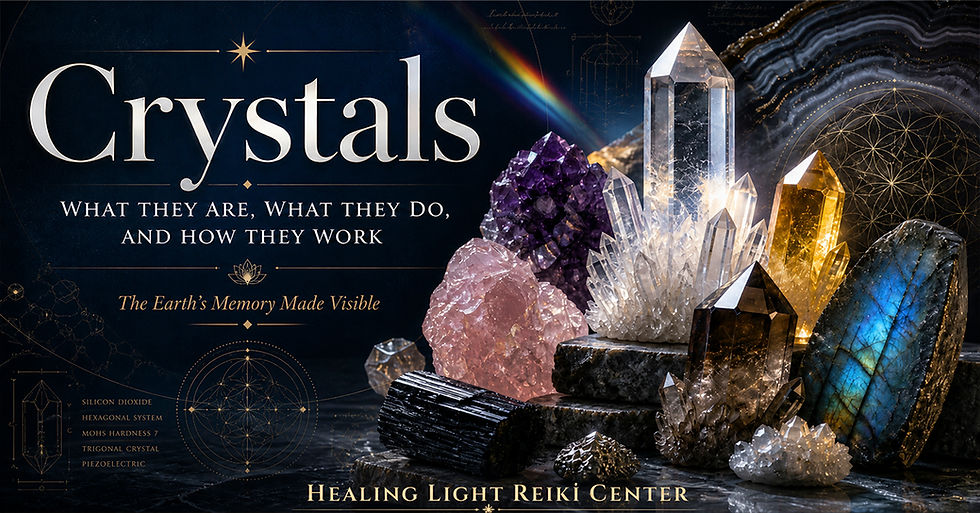
What Crystals Are
To understand crystals clearly, it helps to separate two words people often use interchangeably: crystal and mineral.
A crystal is defined by structure. Its atoms, ions, or molecules are arranged in an ordered repeating pattern. A mineral is a naturally occurring inorganic solid with a specific chemical composition, orderly internal structure, crystal form, and physical properties. Many crystals used in spiritual or decorative contexts are minerals, such as quartz, amethyst, calcite, fluorite, selenite, pyrite, and tourmaline.
Think of a crystal as a song made physical.
Each mineral has its own “score”: a specific arrangement of elements, bonds, angles, densities, colors, fracture lines, and optical behavior. Quartz is silicon dioxide. Amethyst is purple quartz colored by trace elements and natural irradiation. Rose quartz gets its soft pink tone from microscopic inclusions or trace elements. Citrine, smoky quartz, clear quartz, and amethyst all belong to the quartz family, yet each tells the same basic mineral story in a different emotional accent.
A rock is usually a mixture. A crystal is more like a repeated sentence.
The sentence may be tiny, atomic, invisible to the eye. But repeat it enough times, and it becomes a point, a wand, a cluster, a cube, a blade, a geode, a cathedral.
How Crystals Form
Crystals form when nature has enough of three things: material, conditions, and time.
Some grow from cooling magma. Some form when mineral-rich water moves through cracks in stone and leaves behind deposits. Some emerge through evaporation, pressure, or metamorphic transformation. In each case, atoms settle into patterns according to their chemistry and environment.
This is why crystals often feel ancient even when they are newly purchased. They are objects formed by slowness. A crystal is not manufactured in the emotional sense. It does not hurry. It becomes itself through repetition.
One of the most beautiful scientific details is that a crystal’s outer shape can reveal its inner structure. The visible form of a mineral often expresses the hidden architecture of the crystalline substance inside — the repeated three-dimensional arrangement of its chemical units.
That means a crystal is not merely decorated with geometry.
It is geometry.
Why Crystals Look and Feel Different
Crystals differ because their chemistry and structures differ.
Some are hard, like quartz. Some are soft, like selenite. Some split cleanly, like mica. Some sparkle because of metallic bonding or reflective surfaces. Some glow, shimmer, change color, or appear to contain mist, smoke, gardens, stars, or frozen rain.
Their physical properties are shaped by chemical bonds and internal structure. Mineral hardness, cleavage, melting point, electrical conductivity, thermal conductivity, and other properties are largely related to bonding forces within the crystal.
This is where science and symbolism begin to brush against each other.
A piece of black tourmaline feels different from rose quartz not only because people have assigned different meanings to them, but because they are materially different. Their color, density, weight, opacity, texture, and shape create different sensory experiences. You do not need to believe in crystal healing to notice that holding a jagged piece of smoky quartz feels different from holding a smooth piece of moonstone.
The body responds to texture.The eye responds to color.The mind responds to symbol.The heart responds to meaning.
A crystal enters through all of these doors.
What Crystals “Do”
This is the question most people ask first: What do crystals do?
The most honest answer is layered.
Scientifically, crystals have real physical properties. Quartz, for example, is used in technology because of its piezoelectric properties, meaning it can generate an electric charge under mechanical stress and can help regulate frequency in devices. Other crystals and crystalline materials are used in lasers, watches, electronics, optics, semiconductors, and countless industrial applications.
But when people ask what crystals do in a healing or spiritual context, they usually mean something more intimate:
Can they calm me?Can they protect me?Can they help me manifest?Can they clear energy?Can they support love, courage, sleep, intuition, grief, focus, or grounding?
This is where we need clarity.
Crystals should not be treated as medical tools or replacements for qualified healthcare. Complementary practices should be considered carefully and safely, and they should not replace necessary medical or mental health care.
But crystals can still “do” something meaningful.
They can help create ritual.They can focus attention.They can make intention tangible.They can act as symbolic anchors.They can remind the nervous system to pause.They can beautify space in a way that changes mood.They can connect a person to earth, time, color, and texture.They can give the hand something steady to hold when the mind feels scattered.
In that sense, crystals work less like pills and more like thresholds.
They invite us into a different quality of attention.
How Crystal Healing Works
Crystal healing is often described as the practice of using crystals to balance, clear, amplify, or harmonize energy. Different traditions assign different meanings to different stones. Amethyst may be associated with intuition or calm. Rose quartz with love or emotional softness. Black tourmaline with protection or grounding. Citrine with confidence or abundance. Clear quartz with clarity or amplification.
But the most interesting way to understand crystal healing is this:
A crystal gives the invisible something visible to gather around.
An intention can be abstract.A grief can be shapeless.A prayer can feel too large.A desire for change can drift away by morning.
But place a stone in your hand, and suddenly the inner world has a form.
A crystal can become a physical witness to a private decision.
You choose rose quartz not because the stone magically solves heartbreak, but because you are choosing to sit with the part of you that still wants to soften. You choose smoky quartz not because it erases fear, but because you need an object that feels dense enough to remind you of the ground. You place amethyst beside the bed not because it guarantees spiritual dreams, but because you are creating an environment where rest, quiet, and inwardness are invited.
This is subtle work.
It is not control.It is relationship.
The Three Ways Crystals May Affect Us
There are three main ways crystals can matter in a person’s life: sensory, symbolic, and ritual.
1. The sensory effect
Crystals engage the senses. Their coolness, weight, color, shape, sparkle, translucence, and texture all communicate with the body. A smooth palm stone can be soothing because it gives the hand a repetitive tactile experience. A clear crystal in sunlight can shift the feeling of a room. A deep blue stone may visually suggest quiet; a red stone may suggest warmth, vitality, or courage.
This does not require supernatural belief.
Beauty changes atmosphere.
Atmosphere changes us.
2. The symbolic effect
Humans are meaning-making creatures. We respond to symbols constantly: wedding rings, medals, candles, flags, heirlooms, photographs, religious objects, letters, keys, flowers.
A crystal can work in the same symbolic language.
It can stand for something we are trying to remember.
Carry a small piece of hematite, and it may become a reminder: Come back to your body.Keep citrine near your workspace, and it may whisper: Let your work have warmth and courage.Place moonstone on an altar, and it may say: Trust cycles. Not everything blooms at noon.
The crystal is not doing the emotional work instead of you.
It is helping you remember the work.
3. The ritual effect
Ritual is attention with a shape.
When you cleanse a stone, hold it during meditation, place it by your bed, create a grid, set an intention, or arrange crystals on an altar, you are doing something ancient: you are using matter to mark meaning.
Ritual tells the nervous system, This moment is different.
It creates a boundary between ordinary time and intentional time. Even a simple ritual — holding a stone, taking three breaths, naming what you want to release — can become a doorway into presence.
Crystals are especially good ritual objects because they feel both earthly and otherworldly. They are born from geology, yet they look like they belong to dreams.
Why Certain Crystals Are Associated With Certain Meanings
Crystal meanings come from many sources: color symbolism, cultural associations, mineral appearance, historical use, intuitive tradition, and modern metaphysical systems.
For example, green stones are often associated with the heart, growth, renewal, nature, and healing because green already carries those meanings in the human imagination. Black stones are often associated with protection or grounding because black suggests depth, boundary, absorption, and the unknown. Clear stones are linked with clarity because transparency itself becomes symbolic.
Sometimes the meaning comes from the stone’s behavior.
Selenite is soft, pale, luminous, and easily scratched, so people often associate it with gentleness, light, and spiritual clearing. Pyrite looks metallic and golden, so it becomes associated with confidence, wealth, vitality, or fire. Labradorite flashes with hidden color, so it naturally lends itself to themes of mystery, intuition, and hidden potential.
This is part of what makes crystals fascinating. Their meanings are not arbitrary in the emotional sense. They often arise from a conversation between the stone’s physical qualities and the human imagination.
The Crystal Is Not the Power. The Relationship Is.
One of the most original ways to think about crystals is this:
A crystal is not a vending machine for spiritual results.
It is a relationship object.
It does not replace your intuition. It helps you practice hearing it. It does not remove grief. It may help you sit beside grief with more tenderness. It does not manifest your life for you. It may help you become more conscious of what you are choosing, repeating, avoiding, or calling in.
In other words, the crystal is not there to overpower your life.
It is there to participate in your attention.
This is why two people may use the same stone differently. One person’s amethyst may be about sleep. Another’s may be about sobriety, prayer, intuition, mourning, or protection. The stone holds a general symbolic field, but the relationship becomes personal.
A crystal becomes powerful when it becomes specific.
Crystals as Earth Companions
There is another layer that is easy to overlook: crystals connect people to the earth at a time when many of us live increasingly disembodied lives.
We spend hours in screens, language, opinions, alerts, deadlines, and digital abstraction. A crystal is stubbornly physical. It has weight. Temperature. Texture. Edge. Age. It asks to be held rather than scrolled.
To keep a crystal nearby is to keep a fragment of deep time in your ordinary life.
This may be one of the quietest gifts crystals offer. They remind us that not everything meaningful moves quickly. Not everything grows visibly. Not everything beautiful is soft. Some transformations happen underground, in darkness, under pressure, molecule by molecule.
That is not a bad metaphor for healing.
How to Work With Crystals in a Clear, Grounded Way
Working with crystals does not need to be complicated.
Start by choosing one stone, not twenty. Choose it because you are drawn to it, because its color affects you, because its traditional meaning resonates, or because it feels good in your hand.
Then give it a purpose.
Not a demand. A purpose.
You might say:
This stone reminds me to speak gently to myself.This stone helps me return to my breath.This stone marks my commitment to rest.This stone represents protection while I practice better boundaries.This stone helps me remember that I am allowed to begin again.
Place it somewhere meaningful: beside your bed, near your journal, on your desk, by the bath, in your pocket, or on a small altar. Let it become part of a practice.
The crystal does not need to be rare or expensive. A simple piece of quartz, a river stone, or a small tumbled amethyst can be enough. The point is not luxury. The point is attention.
Cleansing, Charging, and Caring for Crystals
Many people like to “cleanse” or “charge” crystals. Metaphysically, this is often described as clearing old energy and refreshing the stone’s vibration.
Practically, it can also be understood as renewing your relationship with the object.
You are saying: I am beginning again with this tool.
Common methods include moonlight, sound, smoke, breath, intention, placing the stone near selenite, or setting it somewhere peaceful. Some people use salt or water, but be careful: not all crystals are safe in water or salt. Selenite, for example, is soft and can be damaged by moisture. Malachite, pyrite, hematite, and other minerals may also react poorly to water or contain elements that should be handled thoughtfully.
A simple, safe method is to hold the stone and say:
Thank you. I release what is no longer needed. May this be used with clarity, care, and good intention.
That is enough.
Not everything sacred has to be complicated.
A Few Favorite Crystals and Their Deeper Symbolism
Clear quartz is often associated with clarity and amplification. Its transparency makes it feel like a clean window for intention.
Amethyst carries a contemplative quality. Its violet color has long been associated with spirituality, sobriety, intuition, and quiet.
Rose quartz is linked with love, but not only romance. Its deeper teaching is receptivity: the courage to soften without abandoning yourself.
Black tourmaline is commonly used for grounding and protection. Symbolically, it is the stone of boundaries — the ability to remain yourself in a noisy world.
Citrine is associated with confidence, abundance, and warmth. It feels like sunlight translated into mineral form.
Labradorite is the stone of hidden color. At first glance it may look gray or dark, then suddenly flash blue, green, or gold. Its symbolism is almost unavoidable: there is more here than first appears.
Selenite feels like moonlight in mineral form. It is often associated with clearing, softness, and spiritual stillness.
Carnelian carries warmth, courage, creativity, and life force. It is less about calm and more about returning to the flame.
What Crystals Cannot Do
A grounded article about crystals should be honest about limits.
Crystals cannot replace medical care.They cannot guarantee healing.They cannot force love, money, health, or protection.They cannot do your emotional work for you.They cannot override consent, reality, or responsibility.
But limits do not make them meaningless.
A candle cannot solve grief either, yet lighting one can matter.A wedding ring cannot create love by itself, yet it can hold a vow.A photograph cannot bring back the past, yet it can keep memory close.
Objects matter because humans are embodied beings.
We need things to touch.We need beauty.We need reminders.We need rituals that help the inner life become visible.
Crystals belong to that ancient human need.
The Most Beautiful Way to Understand Crystals
Crystals are not magic rocks in the cartoon sense.
They are also not meaningless decorations.
They live in the mysterious middle: scientifically fascinating, visually powerful, symbolically rich, and spiritually useful when approached with intention.
A crystal is earth shaped by time.
A crystal is order emerging from pressure.
A crystal is a small architecture of patience.
And when we work with one, perhaps we are not asking the stone to save us. Perhaps we are asking it to teach us its oldest lesson:
Become clear by returning to your structure.Become beautiful without rushing.Let pressure shape you, but not erase you.Hold light in the places where you have edges.Remember that even in darkness, something precise and luminous can be forming.
That may be what crystals do best.
They remind us that healing is not always a lightning strike.
Sometimes it is a pattern, quietly repeating, until one day it becomes visible.
Comments